Your platform
Your team will add a field, change a versioned business rule or pull data through an open API, without waiting on a vendor ticket.
- Custom fields and versioned rulesPlannedDec 2026
- Open, documented APIPlannedDec 2026
For corrugated box plants, sheet feeders and sheet plants
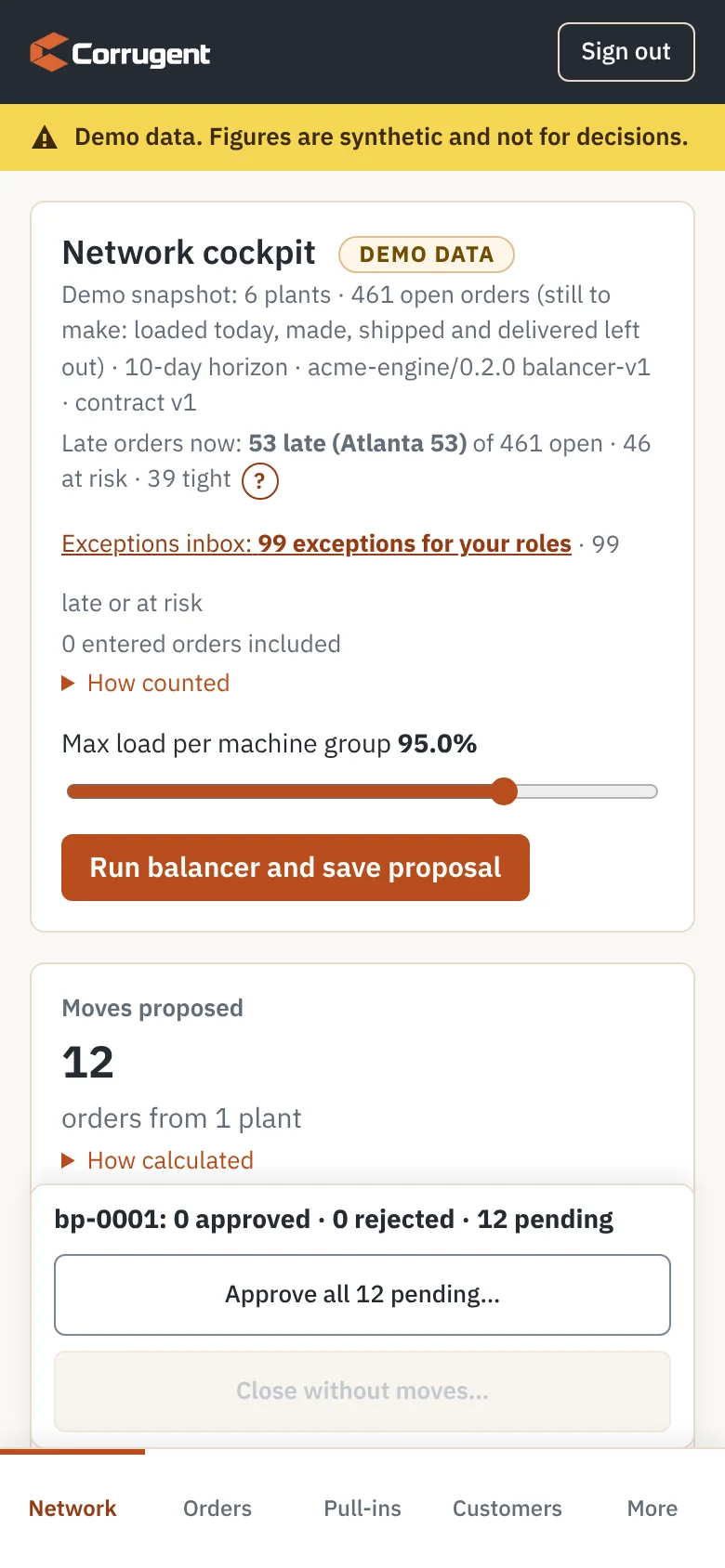
An operating platform for every plant you run, being built from quote to cash and open to your IT team. Live in the demo today: a network balancer that shows what each move does to due dates and estimated contribution before anyone commits.

For IT leaders
IT teams at corrugated producers know the pattern: slow releases, rising bills, and every change waiting in a vendor queue. We are building the alternative, and we label how far along each part is.
Your team will add a field, change a versioned business rule or pull data through an open API, without waiting on a vendor ticket.
Replace your current ERP and MES in one move, or phase it in module by module. Today, a simulated import from legacy exports reconciles to the cent.
The platform runs on serverless AWS services whose cost scales with use. A five-year TCO calculator compares it with what you spend today, using only figures you enter.
Your own AI agents will use the platform through scoped tools, with every action logged and consequential ones waiting for a person to approve.
Network balancer
The balancer looks at every machine group in every plant, finds the overload, and proposes order moves that relieve it and recover late orders. Each move is checked for machine capability and the customer’s approved plants, then replayed through the receiving plant’s run sequence, day by day on a shared plant calendar, so it still arrives by its due day without making another order late. Every move is priced for freight, variable conversion and moving its die and plates (draft). The engine only proposes; a planner approves or rejects every move.
Relief has a price, and the cockpit shows it before anyone commits. In the demo, relieving Atlanta costs an estimated $9,605.79 of contribution, mostly extra freight, partly offset by lower conversion cost, explained move by move, and cuts late orders across the network from 53 to 9. At-risk orders rise from 46 to 60: some orders no longer late have a step on a machine shown down, most of them put there when Atlanta’s work was re-sequenced, and late outranks at risk, so late or at risk falls from 99 to 69. It does not clear lateness already on the books: 9 Atlanta orders are still late. The balancer moves orders first to bring load under the ceiling, then to recover lateness where a draft value of a late order-day outweighs the contribution a move costs, and the cockpit gives the reason each late order stays late, including when another plant could take it on time.

Demo data: fictitious 6-plant network, 461 open orders, 10-day horizon, 95% load ceiling.
Live in demoExplainable by default
Open a figure in the cockpit to see how it was calculated. Each proposed move shows its checks, its cost deltas, the engine and rule version, and a check that the parts add up. Recommendations expose their assumptions and trade-offs; they never chase utilization or volume on their own.
Live in demo

EBITDA and on-time-in-full
The decisions that move EBITDA and on-time-in-full delivery are made with estimates. We keep the estimate, the realized result and the reported figure apart, so nobody mistakes one for another.
What a quote or a plan change should earn, before you commit to it.
Used by planning, estimating and salesWhat each order actually earned, once it was made and shipped. Today: realized contribution against the estimate.
Used by sales, plants and financeThe financial result your finance team reports, from the ledger.
Owned by financeWho it’s for
Estimators, sales, planners, operators, inventory, shipping, quality, finance, leadership and IT: each role is getting screens designed for its work, on a desk, a phone or a plant-floor tablet. See what is live for each.
No surprises in the demo
Every capability on this site carries its status, and the demo app shows its version, deploy time and known limitations on every screen.
We rebalance the overloaded plant in the six-plant demo network live, open the working behind each move, and take your IT team’s questions on architecture, security and migration.